What Does “Liberal” Mean Now?
Part Six: From political philosophy to culture-war shorthand, a word pulled in many directions

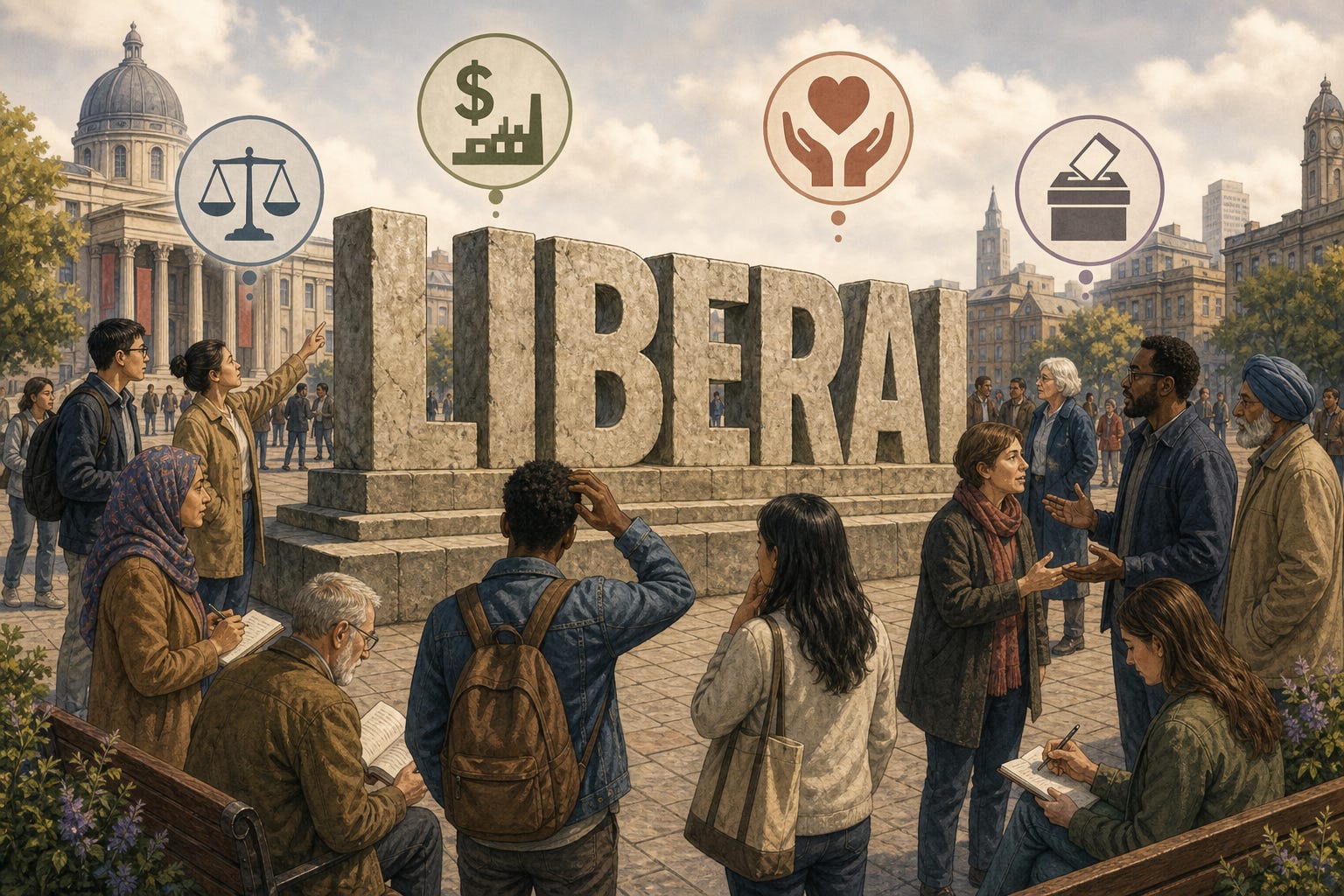
Across the English‑speaking world, people argue fiercely about “liberal values,” attack “liberal elites,” defend “liberal democracy,” and campaign under Liberal party banners.
In this series, we have explored words that function as polysemic colossi — towering conceptual landmarks we use to navigate civic life, but whose meanings have multiplied and diverged over time. The word liberal belongs squarely in this category. It is a polysemic colossus: a single, heavily loaded word with multiple, historically layered meanings that different groups treat as obvious, non‑negotiable, and morally charged. To delve into the meanings of the word liberal in a short post, it’s necessary to summarize centuries of thinking and linguistics, so please forgive the generalizations.
When liberal has multiple meanings, politics becomes harder to learn, harder to join, and easier to manipulate, not only within one country but across borders.
For newcomers to English, for citizens without a political theory degree, and for anyone trying to follow public debates in good faith, this is not a minor semantic quibble. When a colossus word like liberal can mean “free market minimal state” in one context and “big activist welfare state” in another, politics becomes functionally unlearnable at every level. If politics are unlearnable, they become dysfunctional and exclusive.
Where the word liberal comes from
The word liberal traces back to the ancient Latin liberalis, “befitting a free person,” related to liber, “free.” In Roman usage, liberalis evoked the status, education, manners, and generosity appropriate to a free citizen, in contrast to the servility expected of slaves. That root gave us the “liberal arts” — studies fit for free people — long before it gave us a political ideology.
When early modern European thinkers began to challenge absolute monarchy and hereditary privilege, they reached back to this vocabulary of freedom. In this context, liberal named a political project: replacing rule by kings and inherited estates with rule based on the natural freedom and equal worth and dignity of individual human beings.
Classical liberalism: liberty against kings
What many now call classical liberalism grew out of the European Enlightenment struggles against absolute monarchy and aristocratic privilege. Leading thinkers argued for religious tolerance, government by consent, natural rights, and popular sovereignty at the end of the 17th century. They explored popular sovereignty and the “general will” as foundations for a free society.
These concepts were applied to the production and exchange of goods and services, laying the groundwork for economic liberalism, arguing that markets, when left relatively free, can coordinate economic activity more effectively than heavy-handed state control. A powerful defence of individual freedom and autonomy in social and political life was embraced: the “harm principle”- power should only be used against someone’s will to prevent harm to others.
Combined, the ideas explored between the 17th and 19th centuries in the West developed an explicitly liberal program: free markets, private property, limited government, civil liberties, and the rule of law- what later came to be called classical liberalism.
In this sense, to be liberal meant:
Government exists to protect pre‑existing individual rights.
Economic life should be governed mainly by free contracts and markets.
State power should be constrained by constitutions, rights, and checks and balances.
This is the meaning many historians and economists still have in mind when they use phrases like classical liberal or economic liberal: a politics of negative liberty — freedom from interference — in both civil and economic life.
In this classical sense, to be liberal was to support limited government, free markets, civil and political rights, and legal equality — defining itself against absolutism and feudal privilege of aristocracy and monarchy.
Social liberalism: freedom needs support
Late in the 19th century, industrialization, urbanization, and the rise of wage labour exposed the limits of classical liberalism’s “you’re free because the state leaves you alone” view of liberty as freedom from interference.
If you are formally free but trapped in grinding poverty, unable to access education or health care, or structurally excluded by discrimination, how meaningful is that freedom?
Idealist thinkers argued that the state might need to act not only to protect freedom, but to enable it by removing social barriers to self‑realization. The state has a role in securing the common good and enabling individuals to realize their potential — and that is true liberty.
In the early 20th century, following severe economic upheaval and depression following World War I, it was noticed that a huge swath of the population’s lives were ruined. The case was made for active government intervention to stabilize economies and reduce the human cost of recessions. In practice, this shifted liberal people toward:
Social insurance and welfare programs
Worker protections and labour standards
Public education, health systems, and infrastructure
Civil‑rights protections for historically marginalized groups
In this social‑liberal sense, liberal now meant not only freeing people from oppressive states, but also empowering them through education, health care, social insurance, and labour protections. The word shifted from “keep the state small” toward “use the state to make freedoms real” by deepening welfare‑state commitments to redistribution, public services, and regulation in the name of social justice and equality.
In practice, these ideas fed a more activist version of liberalism that became especially prominent in early-mid 20th‑century North America and Western Europe, often associated with social‑democratic reforms, and welfare‑state policies such as Franklin D. Roosevelt’s New Deal in the 1930s, which combined economic intervention and social programs under a broadly “liberal” banner.
Two kinds of liberty inside liberalism
Mid‑20th‑century theorists began naming this internal tension and the same word liberal could mean either “keep the state small and markets free” or “use the state to correct market failures and injustices”.
Public intellectuals distinguished between negative liberty — freedom from interference — and positive liberty — freedom to act or to become the kind of person one has reason to be. They did not think one was automatically good and the other bad, but warned that positive liberty can, if misused, justify paternalistic or coercive policies “for your own good, while negative liberty can fail to free people from the potential-destroying constraints of poverty and ill health.
Respected economists reasserted the classical view: minimal government intervention, strong property rights, free markets, and skepticism about welfare states. They argued expansive government programs threatened economic efficiency and individual freedom.
This distinction created a situation in which people who all called themselves liberal could still disagree sharply. Some stayed close to the classical, negative‑liberty view: protect individuals from both state and mob. Others embraced a more positive‑liberty view: use public power to remove social obstacles that prevent people from flourishing. Both camps claimed the liberal inheritance. So in some contexts, the word liberal meant market‑friendly and anti‑statist, opposed to authority, interference, and power of the state (government) in society; while in other contexts, liberal meant pro‑welfare‑state and egalitarian.
By the late 20th century, liberalism had come to represent different social and economic concepts depending on location — significantly diverging between, for example, the United States and the United Kingdom.
The American twist: “liberal” = left of centre
In the United States liberal has become the everyday label for politics left of centre, especially on social issues and economic redistribution. A liberal American today is expected to favour:
Robust social programs and progressive taxation
Strong civil‑rights protections
Environmental regulation and climate policy
Progressive positions on issues like abortion, LGBTQ+ rights, and gun control
Meanwhile, those who still champion classical “free market” liberalism tend to use other labels — libertarian, classical liberal, or fiscal conservative. On U.S. talk radio, liberal becomes a partisan insult roughly equivalent to “left‑wing activist,” and is sometimes conflated with progressive or socialist.
Today, in the United States, the word liberal has gone from naming a philosophical tradition to naming a tribe. Whatever that tribe believes at a given moment becomes “liberal.”
The European twist: “liberal” = free‑market centre or right
In much of Europe, liberal primarily signals economic liberalism: support for free trade, deregulation, and constrained government, sometimes combined with social progressivism.
Liberal often signals economically pro‑market positions: free trade, competition, and limited state intervention, sometimes combined with civil‑liberty language. Liberal parties tend to sit at the centre or centre‑right: more market‑friendly than social democrats, but not always as culturally conservative as traditional right‑wing parties.
So an American might hear “liberal party” in Europe and expect centre‑left social democracy, but encounter a party that is closer to what North Americans would call “pro‑business,” even centre‑right.
Same word, different political geography.
Liberal in Canada, Australia, and the Commonwealth
In Canada, Australia, and elsewhere in the Commonwealth, Liberal is also a party label, but the parties are not clones of one another. In Canada, the federal Liberal Party combines social‑liberal policies with generally market‑friendly economics, while in Australia, the Liberal Party is usually described as centre‑right and conservative on many issues.
Global political discourse
In the global media environment, international outlets talk about “liberal democracy,” “liberal international order,” or “neo‑liberal globalization,” however, we are not all hearing the same meaning. For a businessperson in Singapore, an activist in Nairobi, or a student in São Paulo reading in English, liberal may point to American culture wars, European economic doctrines, or an abstract ideal of constitutional democracy — sometimes all at once.
Globalization and migration
For newcomers arriving from countries where liberal might mean “secular Western” or where party labels map completely differently, this is bewildering. Even for long‑time citizens, tracking whether the speaker means “Liberal Party,” “classical liberal,” “US‑style social liberal,” or “nebulous ‘woke’ liberal elite” requires a great deal of background knowledge.
Why this is more than a semantic quirk
Given that English is used as the shared language in many international contexts and the word liberal has multiple meanings, it is understandable that an audience scattered across the Anglosphere — and beyond — might not be hearing the same thing when someone says “liberal”.
Polysemy is normal; language has always worked this way. But when a word is pivotal in conversation about civics in a global lingua franca, its ambiguity has real consequences. Confusion and miscommunication in the realm of politics and public life is not benign. It directly affects who feels able to participate in civic life.
The “Problem of Polysemy” around liberal is not confined to one country’s talk shows or civic discourse. It shapes how citizens around the world, reading and listening in English, understand — and misunderstand — core debates about rights, markets, culture, and democracy.
Political actors can exploit the confusion by sliding between meanings — praising “liberal values” when they want to invoke human rights, attacking “liberals” when they want to rally their base against a partisan opponent, and never admitting that they are trading on ambiguity.
When a colossal polysemic word is used without clarification, it becomes high‑context code for insiders and a maze for everyone else — especially newcomers to English or to a given political culture. To understand which of these meanings is being used in a given moment, you often need both Western intellectual history and a feel for local political context — knowledge that many reasonable, engaged citizens do not have.
Public debates become high‑context, insider conversations. That is especially exclusionary in immigrant‑rich societies where many citizens are acquiring both English and local political history at the same time. The lack of clarity about the meaning of the word liberal acts as a barrier to grappling with its meanings.
Cultural distance, internal diversity, and contested liberal freedoms
Some newcomers arrive in Western liberal democracies from moral, religious, and civilizational worlds shaped by different assumptions about personhood, family, authority, obligation, knowledge, and the good life. The distance is not only political. It can also be cultural, epistemological, and ontological: people may differ not just in what they value, but in how they understand reality, truth, selfhood, community, and moral order.
For that reason, “liberal values” may not appear as self-evidently good or universal. To some, they may look partial, culturally specific, overly individualistic, morally destabilizing, or insufficiently attentive to family, tradition, duty, or sacred authority. At the same time, many people who are wary of liberalism in some respects may still value aspects of liberal societies, such as personal safety, legal protections, educational opportunity, economic mobility, and freedom from arbitrary state power.
It is also important not to flatten newcomer communities into a single stance or think of them as a monolith. Such communities are internally heterogeneous. They contain generational differences, class differences, theological differences, political differences, and differences between those who wish to conserve inherited norms, those who want selective adaptation, and those who are actively negotiating hybrid identities across more than one moral world. Some experience liberal society as corrosive; others experience it as protective; many experience it as both at once.
Power is also uneven within communities. Appeals to tradition, culture, or faith may express deeply meaningful forms of belonging and continuity, but they may also mask internal hierarchies or silence dissenting voices. That matters when we ask who gets to define the community, whose interpretation of tradition prevails, and whose interests are protected when “our values” are invoked.
This raises difficult but necessary questions, especially for women in newcomer communities who may want fuller participation in public, civic, and economic life, and who may find in some liberal arguments a language for naming equality, consent, education, mobility, and legal protection. How should we understand the position of women who draw on liberal ideas from within communities whose dominant norms are not themselves liberal? When such women appeal to equality, autonomy, or rights, are they simply assimilating to the dominant culture, or are they engaging in their own forms of moral and political reasoning? And who gets to decide when a woman’s embrace of liberal claims is authentic, strategic, coerced, resisted, or hybrid?
These questions are not easy, and they should be approached with caution. But an inclusive civic conversation cannot avoid them.
Clarity is inclusion
When conversation quietly assumes university‑level familiarity with the Western canon and with current culture‑war scripts, that is not a neutral stylistic choice; it is a hidden entrance requirement that people with practical knowledge, newcomers, many immigrants, and people educated in other traditions or disciplines cannot reasonably be expected to meet.
A discourse that builds on the assumption that everyone knows the many meanings of the word liberal cannot honestly call itself inclusive.
It isn’t difficult to add a brief explanation of your usage of the word:
“In this paragraph, ‘liberals’ refers to self‑identified supporters of the Canadian federal Liberal Party, not to liberalism as a general political philosophy.”
“In this context, ‘a liberal attitude’ simply means being broad‑minded and willing to tolerate a wide range of views and lifestyles, not any particular political program.”
“In this passage, ‘liberal’ is referring to trade rather than democracy: it means low barriers to international commerce, not any stance on domestic social policy.”
“When I say ‘liberal’ in the context of US party politics, I’m using it as shorthand for the contemporary centre‑left: roughly the positions associated with the Democratic Party on social issues and economic redistribution.”
If we are serious about inclusive democracy in an English‑speaking and English‑mediated world, we cannot keep building our political conversations on unspoken, specialized knowledge. When we use polyssemic colossi words like liberal, we need to state which meaning we intend, so that understanding is an invitation into the civic conversation, not a barrier.
Endnotes
The Latin liberalis (courteous, well-bred, gentlemanly, generous, honorable, befitting a free person) and its relation to liber (free from control, independent, unimpeded, or outspoken) are discussed in historical lexicography and etymological sources.https://latin-dictionary.net/definition/25593/liberalis-liberalis-liberal, https://www.latin-dictionary.net/search/latin/liber
For the emergence of classical liberalism as a political philosophy grounded in individual rights, consent, private property, a good starting place is John Locke, the ‘father of liberalism’, especially A Letter Concerning Toleration (1689), Two Treatises of Government (1689/90), and An Essay Concerning Human Understanding (1689/90), In The Social Contract (1762), Jean Jacques Rousseau explored popular sovereignty and the “general will” as foundations for a free society. Adam Smith’s The Wealth of Nations (1776) laid the groundwork for economic liberalism, arguing that markets, when left relatively free, can coordinate economic activity more effectively than heavy-handed state control. In On Liberty (1859), John Stuart Mill offered a powerful defence of individual freedom and autonomy in social and political life, famous for the “harm principle”: power should only be used against someone’s will to prevent harm to others.
The shift from classical to social liberalism in response to industrialization, poverty, and social inequality led to the development of social or “positive” liberalism and the idea that the state may need to act to enable individuals to realize their potential. Idealists like T.H. Green in Lectures on the Principles of Political Obligation (1895) introduced the common good and positive liberty, wherein the state might need to act not only to protect freedom, but to enable it by removing social barriers to self‑realization, enabling individuals to realize their potential—and that is true liberty. For a complementary overview, see discussions of “two traditions of liberalism” in contemporary political theory.
In the early 20th century, economists like John Maynard Keynes in The General Theory of Employment, Interest, and Money (1936) supplied a powerful economic rationale for government intervention to stabilize economies and protect people from the worst swings of capitalism made the case for active government intervention to stabilize economies and reduce the human cost of recessions.
Merriam‑Webster’s exploration of “What exactly is a ‘liberal’?” offers a popular‑level overview of the different contemporary senses of liberal (political, economic, temperamental) in English. https://www.merriam-webster.com/wordplay/liberal-meaning-origin-history
The BBC article “Liberal? Are we talking about the same thing?” uses journalistic examples to illustrate how liberal can point to very different positions in the US, Europe, and elsewhere, reinforcing the idea that it is a polysemic political term. https://www.bbc.com/news/world-10658070
On “liberal democracy,” “liberal international order,” and the contested meaning of liberal in global politics, see concise treatments of these terms in contemporary policy analysis and political theory.
For the role of news style guides and prescriptive/descriptive struggles over language, see the Associated Press Stylebook’s evolution and its impact on journalistic word choice, including around politically charged vocabulary.
https://www.apstylebook.com , https://www.prsa.org/article/from-oxford-commas-to-ai--inside-the-evolving-ap-stylebook, https://awordsmith.com/the-history-of-a-grammar-nerds-bible-evolution-of-ap-style/
John Maynard Keynes, The General Theory of Employment, Interest, and Money (1936), which supports government intervention to stabilize economies and promote social welfare. Franklin D. Roosevelt’s New Deal policies in the 1930s exemplify this turn toward a welfare state liberalism that combines economic intervention with social programs.
On the distinction between negative and positive liberty within the liberal tradition, see Isaiah Berlin, “Two Concepts of Liberty” (1958), which provides a foundational philosophical framework for understanding different kinds of freedom.
For the reassertion of a more market-centred liberalism and debates over the proper scope of the state in the mid 20th century, see Milton Friedman, Capitalism and Freedom (1962), which advocates minimal government intervention and free market policies. The late 20th century sees the meaning of liberalism diverge further, with the term coming to represent different social and economic concepts depending on location, particularly between the United States and the United Kingdom.
This divergence is not just an academic curiosity; it is an active problem for people who still think liberalism is worth defending. In his recent book Centrists of the World, Unite! The Lost Genius of Liberalism (2026)Adrian Wooldridge makes the case for liberal centrism in an age of populism and polarization. He traces the intellectual, cultural, and political histories of liberalism and argues that we now live in an “age of extremes,” with populists and autocrats on the march and a “bewildered” liberal establishment short on confidence and ideas. He urges liberals to rediscover the “lost genius” of their creed—its commitment to constitutionalism, open markets, social mobility, and individual rights—while being more critical of big business that manipulates choices and spreads misinformation, and more realistic about immigration, social disorder, and substance abuse. Wooldridge’s project is, in part, an exercise in lexical rescue: he wants to remind readers what liberalism has meant at its inception and development, and to separate that tradition from the caricatures that dominate contemporary debate, warning against fragmenting into sub‑groups that cannot see the common good they still share.
On the idea that both sides of the political spectrum broaden and shift the meanings of politically salient concepts over time (conceptual “creep”), see C. A. Harper, H. Purser, & T. Baguley, “Do Concepts Creep to the Left and the Right? Evidence for Ideologically Salient Concept Breadth Judgments Across the Political Spectrum,” Social Psychological and Personality Science, 14(3), 319–332 (2023). https://doi.org/10.1177/19485506221104643